On this page
- What is a fractional CFO?
- What does a fractional CFO actually do?
- Do you actually need a fractional CFO? Three questions to ask yourself
- How much does a fractional CFO cost in Australia?
- Fractional CFO vs accountant vs bookkeeper — who do you actually need?
- Signs you've outgrown your accountant — but aren't ready for a full-time CFO
- How to choose a fractional CFO in Australia
- Sources
Your business is past the early-stage hustle and growing fast. Sales are climbing, your bookkeeper's drowning, your accountant turns up once a year with a tax bill, and last weekend disappeared into admin that should have been someone else's job. Then someone on the recommendation circuit said the words "fractional CFO" — and now you're three browser tabs deep, trying to work out whether that's a real solution or just consultant repackaging.
Short version: it's a real role, it costs less than you think, and most Australian businesses in growth stage benefit from one. But not all of them. Not yet.
This article covers what a fractional CFO actually is, what they do day to day, what you'll pay in Australia, and three honest questions that tell you whether you're ready for one — or whether your money's better spent elsewhere first.
What is a fractional CFO?
A fractional CFO is a senior finance executive who works with your business part-time — typically one to eight days a month under a fixed monthly retainer — instead of being employed full-time. You get the strategic input of a Chief Financial Officer without the salary, super, leave, or recruiter fees of a full-time hire.
The model is built for businesses that have outgrown a bookkeeper but can't yet justify a permanent CFO comfortably north of $200,000 base. In practical terms, that's most Australian businesses in growth stage — typically $500,000 to $10 million in turnover, making real decisions about pricing, hiring, expansion or funding, and wanting those decisions backed by data instead of gut feel.
What separates a fractional CFO from your accountant is straightforward — they work in your business, not on it once a year. Rolling cash flow forecasts. Scenario planning before the next big decision. Real numbers behind the pricing call you've been making on instinct. Australian provider CFO On Call frames a typical engagement as one to eight days a month at a fixed retainer — that's the shape of most fractional arrangements you'll see locally¹.
Fractional vs outsourced vs virtual vs part-time CFO — what's the difference?
In the Australian market the four labels get used interchangeably and the differences are mostly cosmetic. Virtual usually means remote-only. Outsourced usually means delivered through a firm rather than a sole operator. Part-time is the literal employment version (PAYG, paid leave, on the books). Fractional is the most common umbrella term and covers all of the above.
What matters isn't the label. It's the engagement model: how many days a month you get, what's actually in scope, who's accountable when something goes wrong, and whether you're paying a fixed retainer or by the hour. Choose by structure, not by name.
What does a fractional CFO actually do?
The job is bigger than "better reporting". A capable fractional CFO replaces a handful of decisions you've been making on instinct with decisions backed by numbers you can defend. In a typical Australian engagement, scope covers:
- Rolling 13-week cash flow forecasts that tell you exactly what your bank balance looks like next Tuesday, in six weeks, and at the end of the quarter
- Scenario planning before any decision over six figures — capital raise, new hire, equipment finance, second location, large inventory order
- Pricing and margin analysis by product line, channel or customer cohort, so you stop subsidising your worst customers with profit from your best
- Capital-raising and lender readiness — clean numbers, defensible forecasts, and a data room banks and investors will actually accept
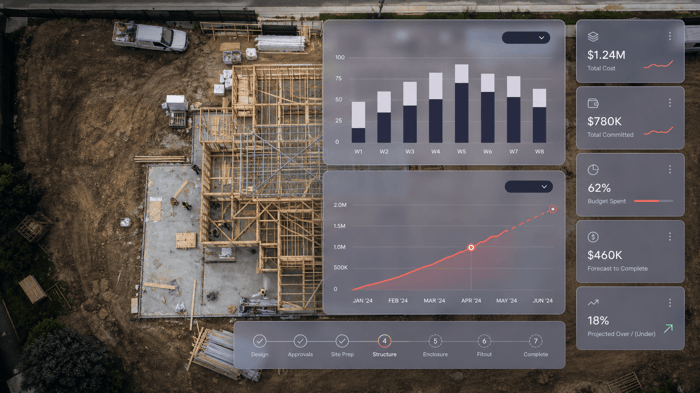
- KPI dashboards and management reporting built around what your business needs, not generic templates
- Board and investor pack preparation for the meetings where vague answers cost you funding
- Tax structure review at a strategic level — flagged here as informational only; specific structure decisions should always come from your registered tax agent
- Growth modelling that ties your hiring plan, pricing, and cash position into a single forward view
This work matters most for the businesses currently struggling with it most. Three-quarters of Australian small businesses reported cash flow issues in 2025, and 64% reported lower profits than the prior year, according to the COSBOA/CommBank Small Business Perspectives Report². Most of those businesses don't have a forward view of cash. A fractional CFO's first month of work usually solves that one problem — and the strategic returns compound from month two onward.
Do you actually need a fractional CFO? Three questions to ask yourself
Most "should you hire a fractional CFO" articles answer with some version of yes, definitely. We don't. Plenty of scaling businesses don't need one yet. The three questions below sort the yet from the now.
1. Can you tell me your cash position 60 days from today?
Not roughly. Exactly. With confidence in the inputs.
If the answer is no, you're flying blind on the single number that determines whether your business survives the next bad month. Cash flow is the top concern for 43% of Australian SMEs, according to NAB's quarterly SME survey³, and almost 80% of Australian small and medium businesses experienced cash flow impacts in the past 12 months⁴.
A fractional CFO's first job is usually to take this question off your plate for good. Rolling 13-week forecast, weekly refresh, three scenarios — base, upside, conservative — and a clear answer to "what does the bank account look like at the end of next quarter?" If you can't answer that today, this is the strongest signal you're ready.
2. Are you making a decision big enough to set the business back six months if it goes wrong?
Capital raise. Senior hire. Equipment finance. New location. Refinance. A large inventory order, a new product line, or a market expansion. Any of these, in the next six months.
The dollar size that counts as "big" depends on your business — for one owner that's $50,000, for another it's $500,000. What matters is the impact: if you get this call wrong, are you spending the next two quarters digging back out?
Decisions at this scale are where growing businesses go backwards. Gut feel doesn't survive the maths. The Reserve Bank of Australia, in its April 2024 speech on SME innovation, identified access to finance and financial visibility as material barriers to growth and innovation for small firms⁵.
A fractional CFO models the decision before you make it: cash impact across 18 months, sensitivity to your three biggest assumptions, and the trigger points where you walk away. Used well, the engagement often pays for itself on a single decision.
3. Is your business growth costing you personally?
Income, hours, weekends, sleep, relationships — pick your unit.
The 2024 Prospa SME data tells an uncomfortable story: 46% of small business owners reduced their own income to keep the business afloat, and almost a third reported less time for personal relationships and leisure⁶. Scaling without a forward view of cash is the most common reason this happens — you hit revenue records on paper while drawing less from the business than you did two years ago.
A fractional CFO doesn't fix this by working harder than you. They fix it by surfacing where cash is actually leaking — pricing, margin, payment terms, headcount, working capital — and giving you a defensible plan to plug it. The personal cost stops being the price of growth.
What if you answered "no" to all three?
You probably don't need a fractional CFO yet. You need clean books, a real chart of accounts, and a bookkeeper who reconciles weekly. Get those right first — most fractional engagements fail when they're hired to do strategy work on top of foundations that don't exist.
How much does a fractional CFO cost in Australia?
Real numbers, not ranges with the actual figure scrubbed out.
Industry benchmarks put a typical Australian fractional CFO retainer in the $7,000–$15,000 per month band⁷. Variance is driven by days per month, business complexity, and whether you're buying through a firm or a sole operator. Some Australian providers price below this band on fixed-fee weekly retainers.
Compare that to a permanent hire. Robert Half's 2025 Salary Guide puts the national base salary for an SME CFO at $200,000 (50th percentile), with a 25th–75th percentile range of $177,500 to $238,000 — base only, excluding super and on-costs⁸. Add 12% Superannuation Guarantee, leave loading, recruiter fees, equity, and the four weeks a year they're not at work, and a $210,000 base hire becomes a $260,000-plus all-in cost. CFO On Call frames the saving plainly: a fractional engagement is typically 60–80% cheaper than a permanent hire¹.
Three real options, side by side:
| Option | Typical AUD cost (annual, ex GST) | Strategic input | When it fits |
|---|---|---|---|
| Bookkeeper only | $15k–$40k | Minimal — transactional | Pre-growth or under $500k |
| Fractional CFO | $26k–$180k (varies by provider and scope) | High — fixed retainer, scoped deliverables | Growth-stage, $500k–$10m revenue |
| Full-time CFO | $260k+ all-in | Full-time, salaried | $10m+ revenue |
Annual ranges shown ex-GST. Most fractional retainers fall in the upper half of the band; entry-tier providers price below.
For most Australian businesses in growth stage, the fractional band is the only model where the maths works.
BPAG's Fractional CFO service is structured around exactly that cohort — businesses turning over $500,000 to $10 million, making real decisions about pricing, hiring, expansion or funding. Fixed weekly pricing, transparent scope, no surprise hourly invoices. See BPAG pricing →
Fractional CFO vs accountant vs bookkeeper — who do you actually need?
Most owners conflate these three roles and end up buying the wrong one. Quick clarification:
| Role | What they do | What they don't |
|---|---|---|
| Bookkeeper | Daily transactions, reconciliations, BAS preparation, payroll | Strategy, forecasting, decision support |
| Accountant (compliance) | Annual tax return, ASIC, structure advice, year-end accounts | Real-time cash flow, growth modelling, weekly numbers |
| Fractional CFO | Forecasting, capital readiness, pricing, board pack, strategic decisions | Day-to-day data entry, transactional admin |
The honest answer for most scaling businesses isn't to pick one of the three. It's to stitch all three together — bookkeeper for the foundation, accountant for compliance, fractional CFO for the strategic layer that wakes up first thing each month and tells you what to act on this week.
What you don't want is the common mistake: hiring a fractional CFO to compensate for a bookkeeper who isn't keeping up. Strategy work on broken foundations doesn't compound — it just costs more.
Signs you've outgrown your accountant — but aren't ready for a full-time CFO
This is the zone fractional CFOs live in. The signs are usually consistent:
- Your tax bill keeps surprising you despite the business being profitable on paper
- Your inventory or revenue data doesn't reconcile cleanly — Shopify, Stripe, Amazon, POS feeds, supplier portals all telling different stories
- A lender or investor has asked for a forecast and what you sent back didn't pass the sniff test
- You're pricing on gut feel — no clear view of margin by product, channel, or customer
- Your quarterly meetings with your accountant feel like history lessons — accurate but twelve months too late to change anything
- You're carrying the financial decision-making personally because no one else in the business has the visibility or context to help
If three or more of those land, you've outgrown a once-a-year compliance relationship. You don't need a $260k full-time CFO yet — but you do need someone with that level of thinking in the business at a level you can actually afford.
That's the gap a fractional CFO is built to fill.
How to choose a fractional CFO in Australia
The market for fractional CFO services in Australia has expanded fast, and the quality range is wide. Five things to evaluate before you commit:
- Industry experience — have they actually worked with businesses in your sector? A fractional CFO who's never reconciled a Shopify-Stripe-Amazon stack, or who's never costed a job in a trades business, is going to spend the first two months catching up
- Tech stack fluency — Xero, Dext, Fathom, A2X, MYOB, job-costing add-ons, integration tools. The right CFO already lives in your tools, not the other way around
- Retainer transparency — fixed monthly or weekly fee, scope defined in writing, no hourly creep. If pricing is "we'll send you a quote after the discovery call", treat that as a flag
- Communication cadence — weekly numbers, monthly strategy, on-call between. Not quarterly Zooms with a deck full of last quarter's data
- References in your size band — three live clients turning over what you turn over, available for a reference call. Testimonials on a homepage are not the same thing
If a provider can't answer cleanly on those five points, keep looking.
This is general information only and does not constitute personal tax, financial or legal advice. Please consult a qualified professional regarding your specific circumstances.
If those three questions made you uncomfortable, the next move isn't a twelve-month engagement. It's a thirty-minute conversation.
No obligation. No hard sell. Just a clear read on whether a fractional CFO is the right move for where your business is right now.
Book Your Free Strategy Call →
Sources
- CFO On Call — Australian fractional CFO provider, typical engagement structure (one to eight days per month, fixed monthly retainer). cfooncall.com.au
- COSBOA / CommBank, Small Business Perspectives Report, 2025 — three-quarters of small businesses reporting cash flow issues; 64% reporting lower profits year-on-year. cosboa.org.au
- NAB Quarterly SME Survey, 2025 — cash flow as top concern for 43% of Australian SMEs. business.nab.com.au
- CommBank / UNSW / YouGov, SMB cash flow survey (n=507) — approximately 80% experienced cash flow impacts in the past 12 months. commbank.com.au
- Reserve Bank of Australia, speech on SME innovation, April 2024 — access to finance and financial visibility identified as material barriers to growth and innovation for small firms. rba.gov.au
- Prospa SME survey, 2024 — 46% of small business owners reduced their own income; approximately one-third reported less time for personal relationships and leisure. prospa.com
- Fractionus, Australian fractional executive market data, 2026 — typical fractional CFO retainer band of $7,000–$15,000 per month. fractionus.com
- Robert Half, 2025 Salary Guide (Australia) — CFO / Finance Director (SME), national base salary 25th / 50th / 75th percentile: $177,500 / $200,000 / $238,000, excluding superannuation and on-costs. roberthalf.com/au